Video: Walking Plan in Tongxiang
Ethan, Tree
CourseworkWalking Plan In Tongxiang is a exercise in a course on “Walking Practice as a Method of Observation in Contemporary Art”. We (Ethan & Tree) present this practice in the form of tri-channel video.
The abstraction of the daily walking process is the primary aspect of the performance. The process of circling the flower beds is often tedious, or the walk is like a hasty march, but it often leaves a trail. The duration of the experience of place as a break from sociality is determined by the number of spectators.
Tree looked more like he wanted to give the act some fresh ideas, repeating his black outfit and accessorizing it with a pair of red-filtered glasses, wearing his latest sports camera gadget on his chest. His state of mind came quickly, and he soon began to dance around as I repeatedly paced around the flowerbed, conceptualizing the next step in the interaction.
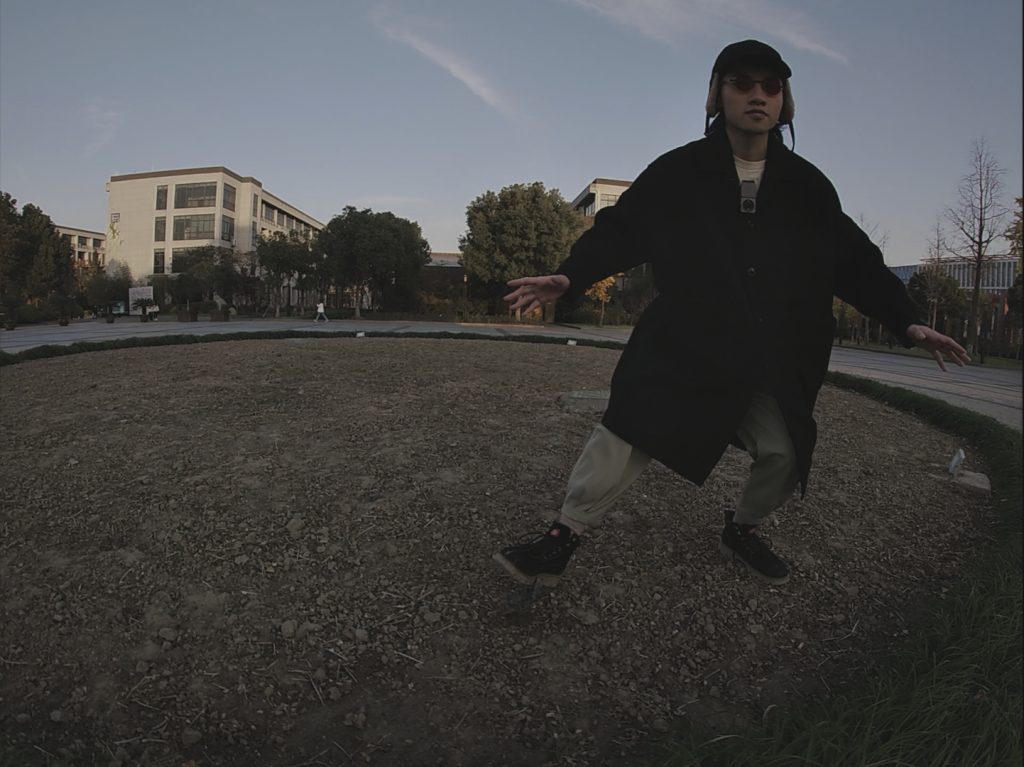
Color, tri-channel video, still frame 01
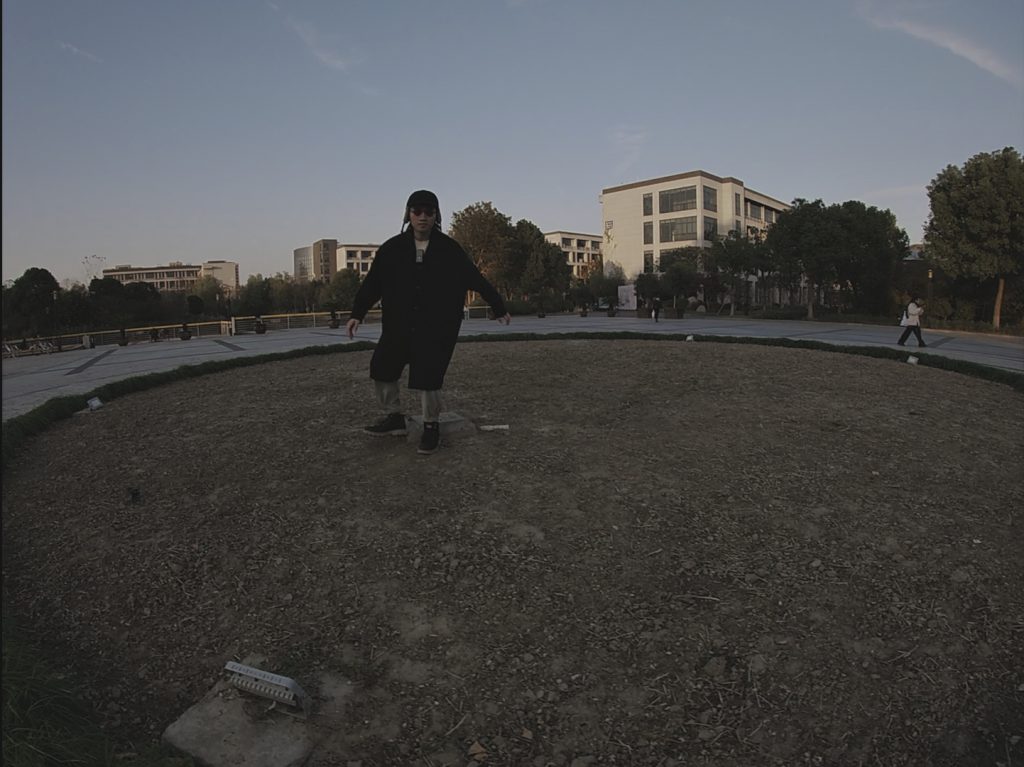
Color, tri-channel video, still frame 02
Breathing, Rhythm, and Interaction
With only the body’s breathing and walking rhythm left, the present moment is called meditation, and the continuation beyond that becomes a walk in the park, and I will be glad to think of the 30 minutes as a single moment.
Tree and I didn’t decide in advance what movements, walking rhythms, breathing rates, and interactions we would have during the process. But we were almost in sync: when he tried to break out, I forced him inside the flowerbed; when he threw stones, I made evasive maneuvers; and eventually, because of exhaustion, we eased our tense rhythm. This process is built into the behavioral transmission between the two of us, and at this time, when class is supposed to be over, there are a lot of murmurs scurrying around us. Oddly enough, walking around the flower beds adds an extra layer of shielding to the line of transmission; even stopping to rest for a few moments can feel like you’re going to be out of the orbit of the flower beds’ movement in the next second.

Walking is undertaken through time and movement in near space (scene) and place (wider location) and often in co-presence with others (c.f. Goffman). We understand our lives by constructing accounts of experiences as within immediate and wider settings (and relations) – the grounding of events, relationships and material circumstance, and in social networks. But our understandings are not simply formed in a linear past-present-future manner; rather, we move forwards, backwards, even side-ways in time conceptions within past, present and future (e.g. as present-past; future-present; past-future) (see Roberts 2004).
步行是通过时间和运动在附近的空间(场景)和地方(更大的位置),并经常与他人共同存在。我们理解我们的生活是通过在直接和更广泛的背景(和关系)中构建经验的意识——事件的基础,关系和物质环境,以及社会网络。但我们的理解不是简单地以线性的过去-现在-未来方式构成的;更确切地说,我们在过去、现在和将来的时间概念中向前、向后、甚至往横向发展。
Much of our voluntary and also involuntary memories are associated with space/place – when we try to bring an incident or an individual to mind we might associate them with a certain location, and then further details may well arise; objects can also be used to aid and stimulate memory. Rumsey argues that recall is a ‘rebuilding process’, as a memory is ‘called up’ for use it becomes stronger whether it is a factual (e.g. an event) or a ‘somatic’ (physical) (e.g. smell, sound, skill) memory – it is taken from the past, modified and placed in sa context of present meaning (Rumsey 2016: 34–7).
She adds that while the relation between memory and physical environment is not well understood, walking is of interest as it is not just a body travelling through space/place, it gives context and stimulation to the mind – as shown by many intellectuals (writers, scientists) and others using the physicality of a walk to release a blockage in thought – something, it seems, we can miss in (‘stationary’) online research (Rumsey 2016: 114: 38-9).
In walking we may reflect on our lives and as ‘instances’ in life ‘recur’ in memory we attempt to fit them – contextualise them: we muse on what is past, what is still present of the past, or on whether what is to come will be the same as now and in our past? In fitting elements of our lives (or relationships, health, education, work, leisure interests, etc.) together we employ a wide range of rhetorical or metaphorical devices – fortune, choice, coincidence, etc. and seek or note what was then our individual ‘changing points’.
In doing so, life it appears becomes a less linear entity, rather also a backwards and forwards movement in perception and understanding – so past events (e.g. an accident) may be viewed in various narrative ways (according to the present and also our perceived future) (Roberts 2004). We might call this ‘constellational thinking’ (O’Neill 2017). ‘Remembering’ something in the past can take place seemingly spontaneously, without warning, or we may ‘retrieve’ an event for renewed consideration – which itself may bring something not expected – and we may give it some modification. While walking, ‘passing’ through a ‘scene’ may bring these kinds of remembering and reworking – and associated emotions and sensations, into our consciousness (as illustrated in Chapter 10). Implicated here is the formation and reformation of the self as embodied, sensual and expressive: we may have particular ‘reminiscences’ of past walks which may raise these dimensions of experience and may be significant for the individual ongoing notions of self, identity and outlook.
我们很多自愿或非自愿的记忆都与空间/地点联系起来——当我们试图想起一个事件或者一个人时,我们很可能会把它们与某个地点联系起来,然后进一步的细节可能就会出现;物体也可以用来帮助和刺激记忆。拉姆齐说,被唤起的记忆是一种重建的过程,作为一种记忆被唤起来使用,它(recall)的(反应)变得更强取决于这是一个事实(例如一个事件)还是一个所谓物理上的实物(例如气味、声音、技能)记忆——(就好比是)它来自过去,修改和放置在一个上下文的意义。
她补充说,虽然记忆和物理环境之间的关系还没有很好地理解,但步行是有趣的,因为它不只是一个身体在空间/地方旅行,它给思维提供了背景和刺激———正如许多知识分子和其他人利用步行的实体性来释放思想上的阻塞——这似乎是我们在(“静止”)在线研究中遗漏的东西。
行走中我们可以反思我们的生活和作为一种我们试图可以唤起记忆的生活瞬间——综上:我们沉思什么是过去,什么是仍然存在的过去,或者是否有将来的东西是与我们的当下与过去是相同的。在我们的生活中(或关系、健康、教育、工作、休闲兴趣等),我们一起使用广泛的修辞或隐喻手段——运气、选择、巧合等,并寻找或注意什么是当时我们个人的“改变点”。
在这样做的过程中,它所呈现的生命变成了一个不那么线性的实体,而是在感知和理解上的一种前后移动——所以过去的事件(如一场事故)可以以不同的叙事方式来看待(根据现在和我们所感知的未来)。我们可以称之为“星座思维”。 “回忆”过去的事情似乎可以自发地发生,没有任何警告,或者我们可能会“检索”一个事件以重新考虑。